

Triangle Calculator
Triangles are one of the fundamental shapes in geometry, widely used in mathematics, engineering, architecture, and everyday problem-solving. Whether you are a student, teacher, engineer, or hobbyist, accurately calculating triangle properties is crucial. Our Advanced Triangle Calculator provides an intuitive and powerful tool to compute a triangle’s perimeter, area, angles, heights, and type with ease.
Why Use a Triangle Calculator?
Manually calculating triangle properties can be time-consuming and prone to errors. Different types of triangles—equilateral, isosceles, scalene—require different formulas. For instance, finding the area may involve Heron’s formula, or you might need height-based calculations. With our triangle calculator, you can:
- Compute triangle perimeter quickly
- Determine triangle area using side lengths or height
- Identify the type of triangle based on its sides
- Calculate all interior angles precisely
- Find heights from each side
- Visualize the triangle in an interactive canvas
- Export results as PDF for reports or homework
This makes it an ideal geometry tool for students, teachers, architects, and engineers who require reliable and accurate triangle calculations.
How to Use the Triangle Calculator
Our calculator is designed for simplicity and usability. Here’s how you can use it:
- Input Triangle Sides: Enter the lengths of side A, side B, and side C in centimeters, meters, or your preferred unit. Ensure that the triangle inequality is satisfied (the sum of any two sides must be greater than the third).
- Calculate Perimeter: The calculator automatically sums the sides to provide the triangle’s perimeter.
- Compute Area: Using Heron’s formula, the tool calculates the triangle’s area. If you know a specific base and height, you can also input the height to calculate area directly.
- Identify Triangle Type: Based on the side lengths, the calculator determines if the triangle is equilateral, isosceles, or scalene.
- Calculate Angles: The calculator uses the Law of Cosines to compute interior angles accurately in degrees.
- Find Heights: Heights (altitudes) from each side are calculated for precise geometric measurements.
- Visualize Triangle: The tool provides a scaled graphical representation of the triangle, allowing you to see its shape and proportions.
- Export Results: You can download the PDF report with all computed properties for record-keeping, assignments, or professional use.
Benefits of Using the Advanced Triangle Calculator
- Accuracy: Eliminates calculation errors by using proven mathematical formulas.
- Time-Saving: Instantly calculates all triangle properties without manual effort.
- User-Friendly Design: Clean, modern interface that works on desktop and mobile devices.
- Educational Value: Helps students understand the relationship between triangle sides, angles, and heights.
- Professional Tool: Suitable for engineers, architects, and designers requiring fast geometry calculations.
Understanding Triangle Properties
Perimeter: The sum of all sides of a triangle. Knowing the perimeter is essential for material estimations in construction or crafts.
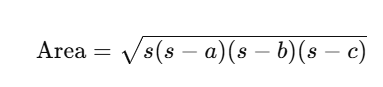
Area: Indicates the amount of space inside a triangle. Our calculator supports Heron’s formula for any triangle type:
where ( s ) is the semi-perimeter, and ( a, b, c ) are the sides.
Triangle Type:
- Equilateral: All sides equal, all angles 60°
- Isosceles: Two sides equal, two angles equal
- Scalene: All sides and angles are different
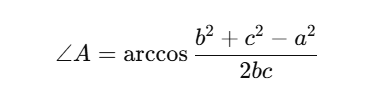
Angles: Calculated using the Law of Cosines, which is critical for determining the triangle’s internal geometry:
Heights: Altitudes from each side can be useful in advanced math problems, physics, and construction design.
Who Can Benefit from This Triangle Calculator?
- Students: Simplifies homework and exams by providing step-by-step accurate calculations.
- Teachers: Offers a reliable tool for classroom demonstrations or grading.
- Engineers & Architects: Helps calculate dimensions for triangular structures and materials.
- DIY Enthusiasts & Crafters: Useful for designing triangular patterns or cutting materials.